
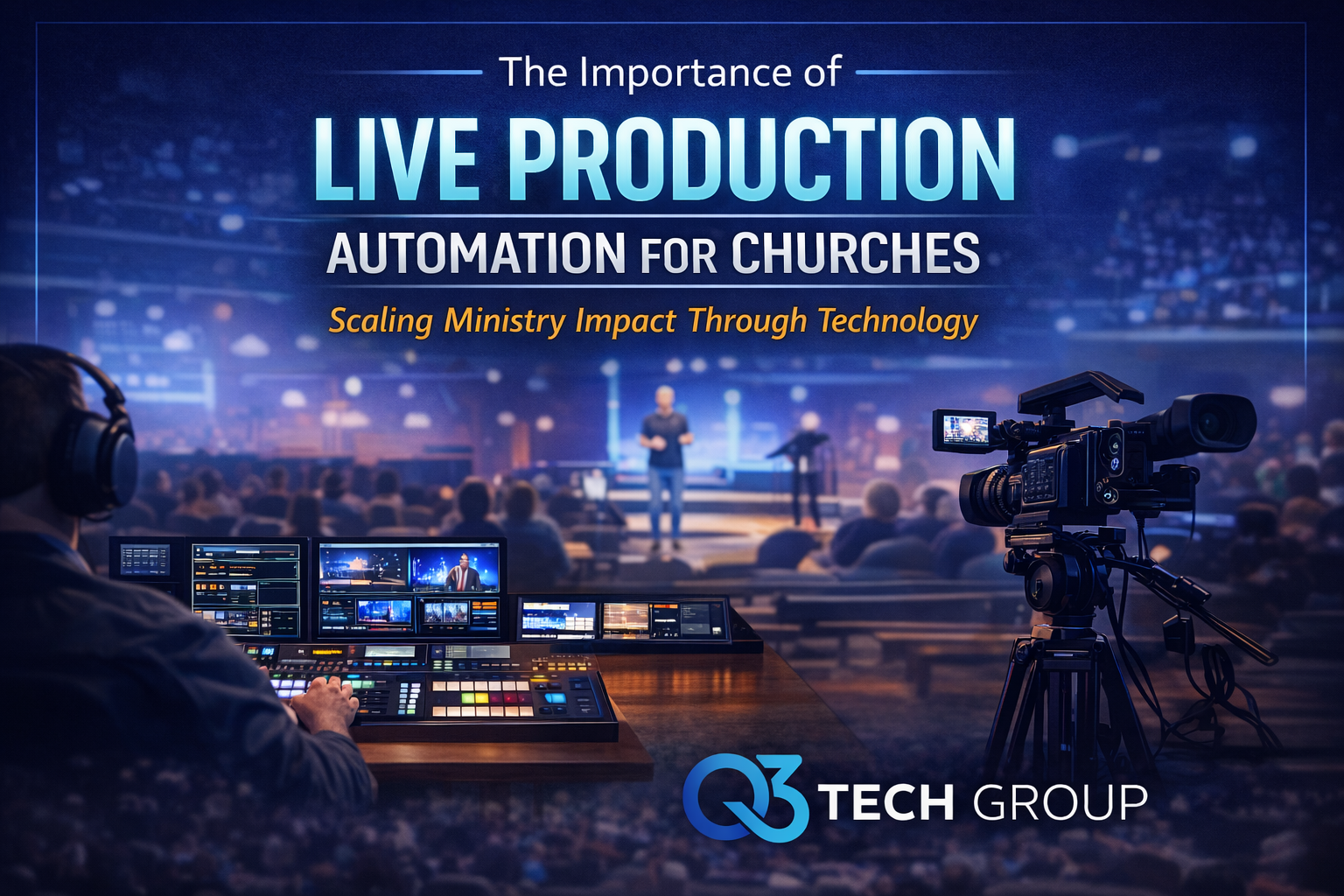
In today’s digital-first environment, the role of technology within the church has evolved dramatically. Live production is no longer simply a behind-the-scenes function; it has become a primary channel through which churches communicate, engage, and grow. Churches are now reaching audiences not only in the room but also online through live streaming, on-demand content, and multi-campus experiences.
As expectations for quality and consistency continue to rise, churches are being challenged to deliver a seamless and engaging worship experience across every platform. However, managing modern church production systems—including cameras, lighting, audio, and streaming—can quickly become overwhelming. This is especially true for ministries that rely heavily on volunteer teams to operate increasingly complex technology environments.
This growing complexity has created a clear need for a more strategic approach. Live production automation for churches is emerging as a critical solution, enabling ministries to simplify operations, reduce risk, and deliver consistent, high-quality experiences without increasing staffing demands.
Live production automation refers to the use of integrated technology systems to standardize and execute production workflows with minimal manual intervention. Rather than relying on individuals to manually control every transition, cue, and adjustment during a service, automation allows churches to predefine how production elements should behave throughout the service flow.
In a well-designed environment, camera angles adjust at the right moments, lighting transitions occur seamlessly between worship and teaching, and streaming elements such as overlays and scene changes are executed with precision. These systems work together to create a cohesive and repeatable production experience that enhances both the in-person atmosphere and the online viewing experience.
The goal of automation is not to remove the human element from worship, but to support it. By reducing the technical burden on production teams, automation allows staff and volunteers to focus on the ministry itself rather than the mechanics of execution.
Churches today are operating in increasingly complex environments. Many ministries host multiple services each week, often supported by different teams with varying levels of experience. In addition, the expansion of online ministry has introduced new expectations around production quality, reliability, and engagement.
Without automation, this complexity can lead to inconsistency. One service may run smoothly while another struggles with transitions, audio levels, or camera work. These inconsistencies are not only noticeable but can also impact how both attendees and online viewers perceive the church.
Automation introduces a layer of consistency that is difficult to achieve manually. By standardizing production workflows, churches can ensure that each service maintains the same level of quality, regardless of who is operating the system. This is particularly important for churches with multi-campus environments, where maintaining a unified experience across locations is essential.
Volunteer engagement is another key factor driving the adoption of automation. Most churches rely on volunteers to operate their production systems, and while this model is powerful, it also presents challenges. Training volunteers to manage complex systems can be time-consuming, and the pressure of live production can lead to stress and burnout. Automation simplifies these environments by reducing the number of decisions and actions required during a service. Volunteers are able to operate within a structured system that guides them through the process, making it easier to serve confidently and consistently.
In addition to improving consistency and volunteer experience, automation plays a critical role in reducing risk. Live production leaves little room for error, and mistakes can be distracting during key moments such as sermons or worship transitions. By predefining workflows and automating execution, churches can significantly reduce the likelihood of these disruptions and ensure that important moments are delivered with clarity and excellence.
Online ministry has become one of the most important ways churches reach new audiences. For many people, a live stream is their first interaction with a church. This makes production quality more than a technical concern—it becomes a matter of first impressions and ongoing engagement.
Automation strengthens church live streaming solutions by ensuring that each broadcast is consistent and professional. Audio levels remain balanced, camera transitions feel intentional, and visual elements such as graphics and overlays are integrated smoothly. This level of quality helps build trust with viewers and encourages continued engagement.
When production issues occur in a live stream—such as audio dropouts, abrupt transitions, or delayed starts—they can quickly lead to disengagement. Automation helps eliminate these issues by creating a predictable and reliable streaming workflow that operates consistently week after week.
As churches grow, the demands on production systems increase. Adding additional services or launching new campuses often requires replicating the production experience in new environments. Without a standardized approach, this process can become resource-intensive and difficult to manage.
Live production automation enables churches to scale more effectively by creating repeatable systems. Once a workflow has been designed and refined, it can be implemented across multiple services or campuses with minimal variation. This allows churches to expand their reach while maintaining a consistent experience for their congregation.
This scalability is particularly valuable for churches pursuing multi-campus strategies or expanding their digital presence. By leveraging automation, ministries can grow without needing to significantly increase technical staffing or rely on highly specialized operators at every location.
While the benefits of automation are clear, many churches struggle to implement it effectively. One of the most common challenges is the presence of disconnected systems. Over time, churches often invest in individual tools—such as lighting consoles, video switchers, and streaming platforms—that function independently but do not integrate well with one another. This creates a fragmented environment that still requires significant manual coordination.
Another challenge is the lack of a clear strategy. Automation is not simply about adding technology; it requires a thoughtful approach to how systems, people, and service flow interact. Without this perspective, churches may invest in tools that are underutilized or overly complex for their needs.
Training and usability also play a significant role. Even the most advanced systems will fail to deliver value if they are not accessible to the people operating them. Ensuring that production environments are intuitive and volunteer-friendly is essential for long-term success.
Q3 Tech Group partners with churches to navigate these challenges and build production environments that are both effective and sustainable. Rather than focusing solely on technology, Q3 takes a holistic approach that considers the unique needs, goals, and structure of each ministry.
The process begins with a comprehensive assessment of the existing production environment. This includes evaluating current systems, identifying inefficiencies, and understanding how services are structured. From there, Q3 develops a strategic roadmap that outlines how automation can be introduced in a phased and practical way.
Technology selection is guided by both current needs and future growth. Q3 helps churches identify solutions that integrate seamlessly and provide long-term value, avoiding unnecessary complexity or overinvestment. The result is a cohesive system where all components work together to support the service experience.
Workflow design is a critical component of this process. Q3 works closely with church leadership and production teams to map out the natural flow of a service and translate it into automated sequences. These workflows are designed to be intuitive, allowing volunteers to operate systems with confidence while ensuring consistency across services.
Training and enablement are also central to Q3’s approach. By simplifying systems and providing clear operational processes, Q3 empowers volunteer teams to succeed. This not only improves execution but also strengthens volunteer engagement and retention.
As churches continue to grow and evolve, Q3 provides ongoing support and optimization. Production environments are continually refined to ensure they remain aligned with ministry goals and capable of supporting future expansion.
Implementing live production automation does not require a complete overhaul of existing systems. In fact, the most effective approach is often incremental. By starting with repeatable elements and gradually introducing automation into key areas, churches can build confidence and realize value at each stage of the process.
Over time, these improvements compound, resulting in a production environment that is more consistent, more efficient, and easier to manage. This allows churches to focus less on technical execution and more on delivering meaningful and impactful worship experiences.
Live production has become a defining component of modern church ministry. As expectations continue to rise and technology environments grow more complex, the need for a strategic approach is clear.
Live production automation for churches provides a path forward. By standardizing workflows, reducing reliance on manual execution, and simplifying volunteer engagement, churches can create production environments that are both powerful and sustainable.
With the right strategy and the right partner, automation becomes more than an operational improvement. It becomes a foundation for growth, enabling churches to communicate their message with clarity, consistency, and excellence.
Q3 Tech Group provides strategic IT and production solutions for churches, helping organizations implement scalable, secure, and efficient technology environments. From church live streaming systems to automation and infrastructure, Q3 partners with ministries to support long-term growth and engagement.

Q3 Tech Group
4381 W Green Oaks Blvd., Suite 106
Arlington, TX 76016
📞 817-483-3800
Q3 Tech Group provides 24/7 managed IT services, co-managed IT support, cybersecurity, business continuity, and AI solutions for churches, nonprofits, and small to mid-sized businesses throughout Fort Worth and the surrounding Dallas–Fort Worth Metroplex. Through a partnership-focused approach, we deliver secure, scalable, and reliable technology solutions that support mission, growth, and long-term resilience.
© 2026 Q3 Tech Group. All rights reserved.
Q3 Tech Group and related marks are trademarks of Q3 Tech Group. All other trademarks and copyrights are the property of their respective owners.

We use cookies to improve your experience on our site. By using our site, you consent to cookies.
Manage your cookie preferences below:
Essential cookies enable basic functions and are necessary for the proper function of the website.
These cookies are needed for adding comments on this website.